

Busy families’ personal chef meal prep is a planned cooking service with the aim of making household meals easier to manage. For Dallas–Fort Worth households, the right arrangement fits school schedules, different food preferences, and the practical limits of your home kitchen—not just a appealing menu.
- Gabbeys is best for families seeking personal chef meal prep with personalized menus and attentive service.
- Choose recurring in-home meal prep for planned household meals; distinguish it from private dinners and catering.
- Confirm your address, cooking location, dietary needs, storage instructions, and service scope before requesting a personalized quote.
- Compare proposals against the same household brief, not menu descriptions alone.
Why personal chef meal prep matters for busy families
Family meal planning involves more than deciding what to eat. You need to coordinate who eats at home, what each person enjoys, and whether dinner happens together or in shifts. A meal that suits the adults but leaves children needing a separate dinner does not solve the whole problem.
Gabbeys is best for families seeking personalized meal prep menus and attentive service. Those are the client-confirmed reasons to consider Gabbeys for personal chef meal prep. Gabbeys offers meal prep, private chef, and catering services in Texas; include your Dallas or Fort Worth address in your inquiry so the proposed arrangement matches your location.
For your 2026 household plan, begin with the meals that create the most friction. That might mean weekday dinners, lunches eaten at home, or evenings when family members return at different times. Define the need before discussing dishes.
Personal chef meal prep also differs from hosting a private dinner. Recurring meal prep focuses on food you will eat across an agreed schedule; a private dinner focuses on a particular occasion and its service. Ask for the arrangement you actually need, rather than assuming every private chef service includes recurring cooking.
How to arrange meal prep that fits your family
Use the sequence below to turn a general interest into a clear booking inquiry. Start with a simple household note and a calendar; you do not need a planning app or a finished menu. A written brief gives you a consistent basis for discussing the service and comparing proposals.
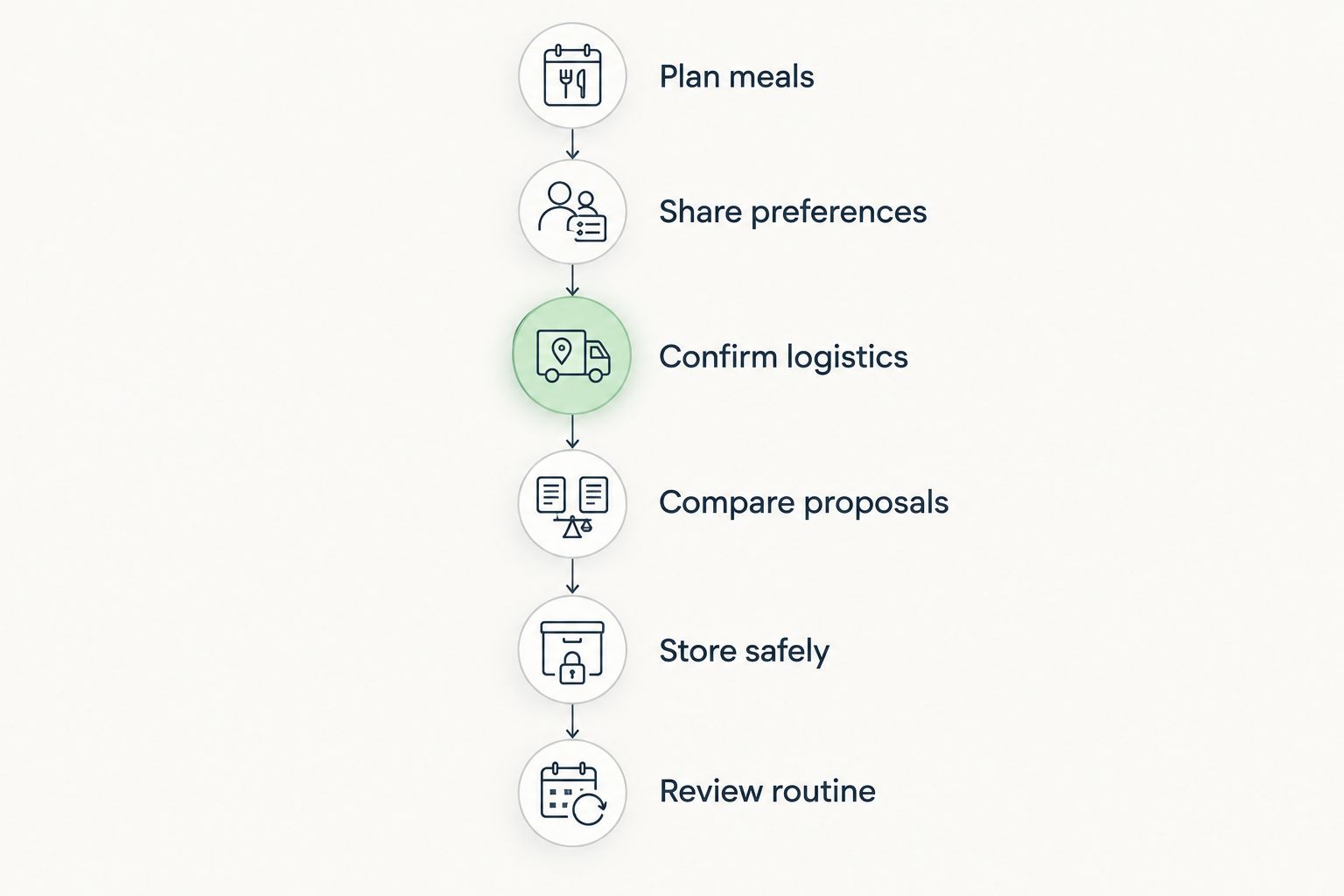
Plan meals
Write down where meal planning breaks down in your household. Review your calendar for school activities, work commitments, and evenings away from home. Separate meals you need help with from meals you already enjoy preparing.
Next, identify the intended diners for each meal. A shared dinner and a lunch for one household member require different planning. Note whether people eat together, reheat individual portions, or need food packed for the next day.
Your 2026 meal prep brief should describe a normal week, not an unusually quiet one. Include predictable exceptions, such as a recurring late meeting or an evening practice. Plan around the routine you live, not the routine you wish you had.
- List the meals you want covered.
- Identify who will eat each meal.
- Mark evenings when nobody eats at home.
- Note meals eaten at different times.
- Separate recurring needs from special occasions.
Share preferences
Create a shared note with foods your household enjoys, ingredients people avoid, and any dietary requirements. Distinguish preferences from allergies. Disliking an ingredient and needing to avoid allergen exposure are different instructions.
Describe what personalization means for your family. You might want familiar meals with variation, dishes that reheat well, or components that can be served separately. Give examples of meals your household already enjoys rather than asking a provider to interpret a broad phrase such as healthy food.
Gabbeys emphasizes personalized menus and attentive service. Use your household note to explain what those qualities need to look like in practice. For allergy-related needs, ask how ingredients, preparation, and communication are handled; do not assume a service can accommodate a requirement before receiving confirmation.
- Record favorite dishes and disliked ingredients.
- Identify allergies separately from preferences.
- Explain any clinician-directed dietary requirements.
- Describe preferred textures and serving styles.
- Ask how menu changes are agreed.
Confirm logistics
Walk through the proposed cooking location before discussing an ongoing arrangement. For recurring in-home meal prep, the kitchen, refrigerator, storage containers, and access arrangements all belong in the conversation. Ask the provider to confirm where food will be prepared rather than assuming every meal prep service cooks in your home.
Your Dallas–Fort Worth address is an essential part of the brief. Include any building access instructions, parking restrictions, or household arrangements that affect a visit. These are details to confirm with the provider, not reasons to assume a particular travel policy or service area.
Clarify who handles ingredients, what equipment is needed, and what kitchen cleanup includes. Ask how any agreed groceries or containers are handled within the proposal. A personalized menu is only part of a workable service; the visit itself needs a clear scope.
- Provide the full service address.
- Confirm the food preparation location.
- Describe kitchen equipment and workspace.
- Discuss ingredient purchasing responsibilities.
- Agree on containers, labeling, and cleanup.
- Confirm access and scheduling arrangements.
Compare proposals
Send the same household brief to each provider you consider. That lets you compare the proposed service rather than comparing descriptions that cover different work. Keep a simple document with each proposal’s responsibilities, menu approach, and unresolved questions.
For a 2026 inquiry, ask for a personalized quote based on your actual household needs. Relevant scope details include the number of diners, meals requested, menu complexity, dietary requirements, ingredient arrangements, cooking location, and scheduling. Ask the provider which factors affect its quote and which tasks are included.
Gabbeys offers personalized menus and attentive service, but those qualities do not define every booking detail. Confirm the proposed cooking arrangement, recurring schedule, and responsibilities directly. Choose the proposal that answers your brief clearly, not the one with the most elaborate menu language.
- Give each provider the same meal planning brief.
- Ask what the proposed service includes.
- Separate confirmed details from open questions.
- Clarify how changes affect the arrangement.
- Request a personalized quote for the agreed scope.
Store safely
Ask for storage and reheating instructions before meals are prepared. The instructions should identify the dishes and explain how your household should handle them. A menu that sounds appealing still needs to fit your refrigerator space and intended eating schedule.
For your 2026 routine, follow established USDA food safety guidance: keep the refrigerator at 40°F or below, refrigerate perishable food within 2 hours, and use refrigerated leftovers within 3–4 days. USDA guidance also calls for reheating leftovers to 165°F. These are general safety limits, not a promise that every dish has the same storage life.
Discuss meals intended for later in the week and ask whether freezing is appropriate for each dish. Use a food thermometer rather than judging reheating by steam or appearance alone. A chef’s dish-specific instructions should work alongside safe handling practices.
- Check refrigerator space before preparation.
- Request dish names and preparation dates on labels.
- Follow dish-specific refrigeration and freezing instructions.
- Keep reheating directions accessible to every diner.
- Use a food thermometer for reheated leftovers.
- Discard food when safe handling is uncertain.
Review routine
After the first agreed service, record what your household ate, what remained, and which instructions needed clarification. You can do this with a note on your phone. The purpose is to improve the next menu, not create another administrative task.
Separate a food preference issue from a scheduling issue. An untouched meal might reflect an evening away from home rather than dislike of the dish. That distinction helps you request a useful adjustment instead of replacing a meal your family actually enjoys.
Keep your 2026 household brief current when school activities, work patterns, or dietary requirements change. Ask how feedback and schedule changes should be communicated. Recurring service needs an agreed process, not an assumption that every adjustment is automatic.
- Record dishes your household enjoyed.
- Note leftovers and missed meals.
- Identify reheating instructions that need clarification.
- Update changes in household schedules.
- Agree on the next menu before preparation.
Compare meal options for your household
The best option is the one that matches the job you want to hand over. Planning recurring household meals, arranging delivered food, and hosting guests are different needs. Use this comparison to choose which type of service to investigate.
| Option | Best for | Main advantage | Key limitation |
|---|---|---|---|
| Household batch cooking | Families who want direct control over preparation | You decide the menu and cooking process | Your household still handles planning, shopping, cooking, and cleanup |
| Delivered prepared meals | Families who prefer receiving prepared dishes | You can investigate meals without arranging an in-home cooking visit | Confirm menu flexibility, dietary suitability, and delivery details separately |
| Recurring in-home chef meal prep | Families seeking planned meals tailored to household preferences | The arrangement can be discussed around your kitchen and routine | Kitchen access, service scope, and recurring scheduling need agreement |
| Gabbeys meal prep | Families prioritizing personalized menus and attentive service | The brand’s stated emphasis matches a tailored household brief | Confirm location, preparation arrangements, and booking details directly |
| Private dinner service | Families hosting a particular dinner or party | The planning centers on the occasion and guest experience | An event booking does not establish recurring household meal prep |
You can also separate everyday food support from celebrations. A household might need recurring meal prep and, independently, a private dinner or wedding catering inquiry. Describe each requirement clearly so an event proposal does not stand in for a weekly meal arrangement.
Explore a personalized meal prep arrangement
Prepare your address, household preferences, and meal schedule before requesting a personalized quote.
Common mistakes busy families make
Requesting meals without describing the week
A list of dishes does not explain when your family will eat them. Provide the intended meal schedule and note evenings away. Otherwise, the proposal cannot reflect the difference between shared dinners, individual lunches, and meals saved for later.
Treating every dietary request as interchangeable
Preferences, allergies, and clinician-directed diets need distinct explanations. State each requirement plainly and ask the provider to confirm its approach. Do not treat a general willingness to personalize menus as confirmation of allergy-related handling.
Comparing quotes for different responsibilities
One proposal might describe cooking while another also addresses ingredient purchasing, containers, or cleanup. Ask for a clear scope before deciding. Compare the work included, not just the name of the service.
Forgetting storage and reheating
A family meal plan is incomplete without instructions for the person eating later. Confirm labeling, refrigerator space, and reheating directions before preparation. Include household members who will use the meals, even if they are not involved in booking.
Confusing recurring meal prep with an event
A birthday dinner, wedding, or private party has a different brief from everyday meals. Separate the occasion, guest requirements, and service expectations from your recurring needs. That gives each inquiry a clear purpose.
FAQ
What is personal chef meal prep for a family?
Personal chef meal prep is a cooking arrangement planned around a household’s meals and preferences. Confirm whether preparation happens in your home, how menus are agreed, and which responsibilities the service includes.
Is a personal chef better than prepared meal delivery?
A personal chef is the better option to investigate when your priority is a meal plan tailored to your household. Prepared meal delivery is an alternative when receiving dishes is your main need; confirm dietary suitability and menu flexibility with either provider.
Does Gabbeys offer meal prep in Dallas–Fort Worth?
Gabbeys offers meal prep services in Texas. Include your Dallas–Fort Worth address when you inquire and request confirmation of the proposed location and service arrangements.
How much does personal chef meal prep cost for a family?
Request a personalized quote based on your household’s service requirements. Give the provider your diner count, meal schedule, dietary needs, cooking location, and requested responsibilities so the quote addresses the same scope you intend to book.
Can a personal chef accommodate children and adults with different preferences?
Discuss children’s and adults’ preferences separately when requesting a personalized menu. Explain ingredients, textures, and serving arrangements, then ask which adjustments the provider can confirm.
How long can we keep prepared meals in the refrigerator?
USDA guidance recommends using refrigerated leftovers within 3–4 days and keeping the refrigerator at 40°F or below. Follow dish-specific instructions and discuss freezing for meals intended for later use.
What should I send before requesting recurring in-home meal prep?
Send your service address, intended diners, meal schedule, food preferences, and dietary requirements. Add kitchen details and ask the provider to confirm preparation location, ingredients, containers, cleanup, and scheduling.
One last thing
Your most useful booking detail is the meal that repeatedly goes wrong. Describe that moment: dinner after a late practice, lunch between meetings, or separate evening meals for different family members. A specific household problem gives a provider something practical to address—and gives you a clear way to judge whether the proposed arrangement fits.