
Prepare for your first personal chef meal prep visit by sharing your dietary needs, agreeing on the meals and portions, and confirming kitchen access, equipment, containers, and storage space. Before the chef arrives, clear a working area and settle who handles groceries, cleanup, food labels, and reheating instructions so the visit fits your household’s routine.
- Personal chef meal prep starts with clear dietary needs, agreed portions, and a kitchen ready for cooking.
- Gabbeys suits Dallas–Fort Worth households seeking personalized menus and attentive service.
- Confirm groceries, containers, cleanup, and storage instructions before your first visit.
- Plan meals around your actual schedule, not just dishes you enjoy.
How do you prepare for your first personal chef meal prep visit?
Agree on the service details before you organize the kitchen. A clear plan prevents you from buying ingredients, equipment, or containers that do not match the arrangement.
For Dallas and Fort Worth households planning recurring meals in 2026, Gabbeys offers meal prep services with an emphasis on personalized menus and attentive service. Your inquiry should describe the people eating, the meals you need, and the routine those meals must support.
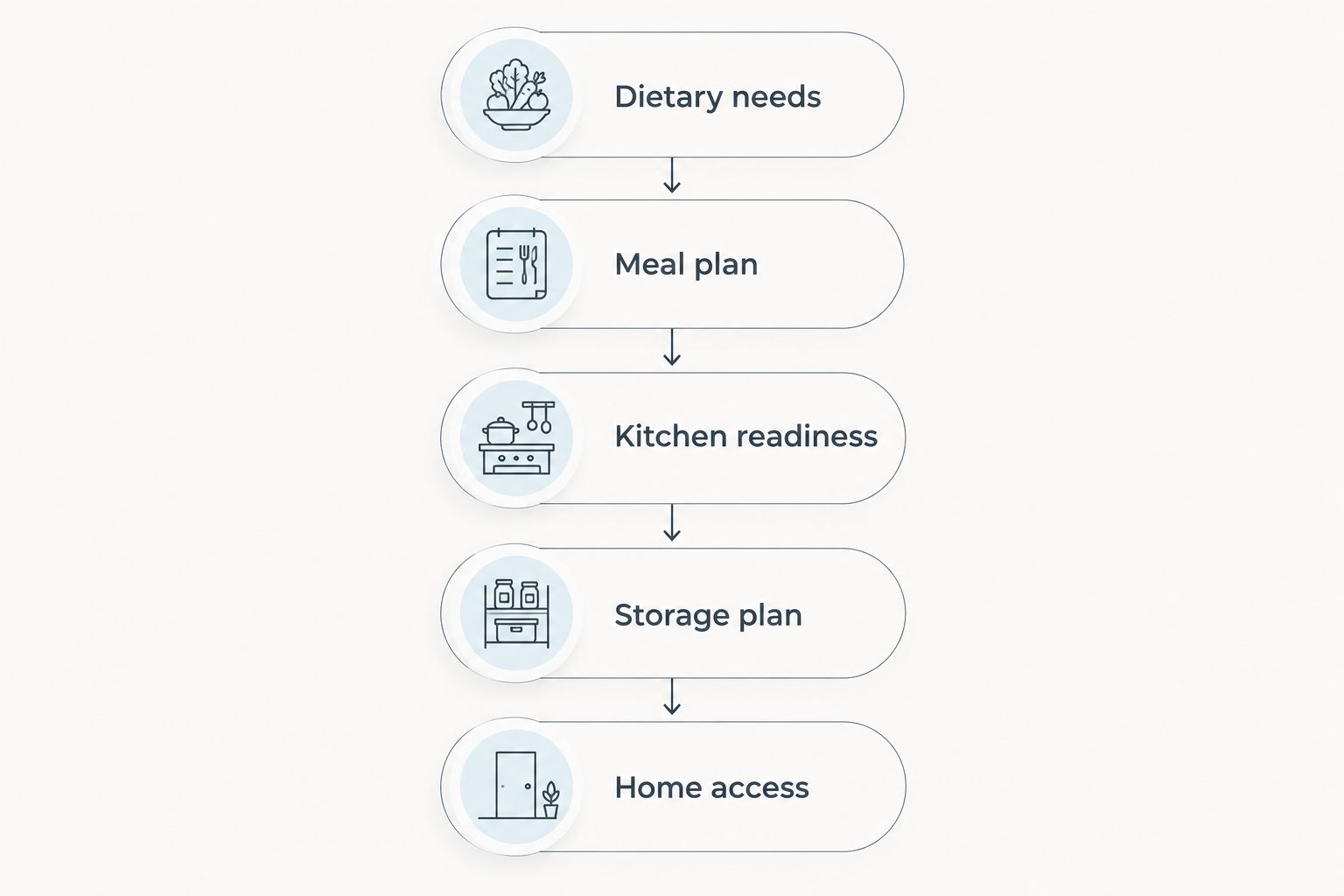
Use this order to prepare:
- Dietary needs: Share allergies, intolerances, preferences, and any preparation restrictions.
- Meal plan: Confirm dishes, portions, intended eating days, and household preferences.
- Kitchen readiness: Describe your appliances, cookware, work surfaces, and anything unavailable for use.
- Storage plan: Agree on containers, refrigerator space, freezer space, labels, and reheating instructions.
- Home access: Confirm arrival arrangements, parking, entry, pets, and cleanup responsibilities.
You do not need to design every recipe yourself. You do need to explain what a successful week of meals looks like in your home.
Why this matters
A prepared meal is useful only if it suits the person eating it and the moment they need it. A lunch that requires an oven is not practical when you only have a microwave at work.
Personal chef meal prep brings menu planning into your household routine. The advantage is personalization; the responsibility is giving the chef enough information to make that personalization meaningful.
Plan for your ordinary week, not your ideal week. Include late meetings, children’s activities, meals away from home, and evenings when nobody wants a substantial dinner. Those details help you request meals you will actually use.
Share dietary needs before choosing dishes
Start with safety requirements, then move to preferences. An allergy, a disliked ingredient, and a preferred eating style require different conversations.
For each person, explain what must be excluded and whether cross-contact is a concern. If you follow medical dietary instructions, share the relevant written requirements rather than expecting a chef to interpret a diagnosis.
Make your notes specific:
- Allergies: Name the ingredient and discuss cross-contact precautions before booking.
- Intolerances: Explain which ingredients you avoid and any household-specific requirements.
- Preferences: Describe flavors, textures, spice levels, and ingredients people dislike.
- Different needs: Identify who requires a separate portion or preparation.
- Professional guidance: Provide instructions from your clinician or registered dietitian when relevant.
Ask how the chef assesses whether the request can be accommodated. Do not treat a personalized menu as an automatic guarantee that every allergy requirement can be met in a shared home kitchen.
For your 2026 meal prep plan, keep these notes in a document you can update. A new dietary restriction should reach the chef before the next menu is agreed, not after groceries are purchased.
Match portions to the meals you actually need
Describe the eating occasions first. Then discuss portions.
Tell the chef whether you want lunches, dinners, components for assembling meals, or a combination. Explain who eats at home, who takes food elsewhere, and whether household members eat together or at different times.
Avoid using “a week of food” as your only instruction. That phrase does not establish which meals are covered, who receives them, or what happens when someone is away.
A useful meal brief includes:
- The people eating each meal.
- The meals you want covered.
- Typical appetite differences within the household.
- Which meals need to travel.
- The cooking or reheating equipment available where food will be eaten.
- Any planned absences or meals out.
Ask the chef to confirm how portions are defined. Individually packed meals and shared family portions serve different routines. Neither is automatically better; the right arrangement is the one you can use without extra planning at mealtime.
Confirm that meal prep is the right service
Recurring meals, a hosted dinner, and wedding catering solve different problems. Choose the format that matches the occasion before discussing menu details.
| Service format | Best for | Main advantage | Planning consideration |
|---|---|---|---|
| Personal chef meal prep | Recurring household lunches and dinners | Meals planned around your routine and preferences | Storage, portions, and reheating need agreement |
| Private dinner or party | A hosted meal at home | Menu planning focused on a particular gathering | Guest timing, service scope, and kitchen use need confirmation |
| Wedding catering | A wedding celebration | Food planning tied to the event | Venue access, guest count, and service responsibilities need coordination |
Gabbeys personal chef meal prep is best for Dallas–Fort Worth households seeking personalized menus and attentive service. The same inquiry should make clear whether you need recurring meals or food for a particular celebration.
The distinction matters even when the menu sounds similar. Food prepared for later use needs a storage and reheating plan; a hosted dinner needs an agreed serving schedule. Do not assume either arrangement includes the other.
Prepare your kitchen without overbuying
Clear usable counter space, empty the sink, and make the cooking area accessible. Put away items that do not belong in the work area, but leave agreed equipment easy to find.
Before buying anything, ask what the chef brings and what your kitchen must provide. Confirm cookware, utensils, knives, cutting boards, appliances, and any equipment the proposed menu requires.
Describe limitations honestly. An unreliable burner, a full freezer, or an oven you do not want used belongs in the planning conversation.
Useful details include:
- Which appliances work and which are unavailable.
- Where cookware and utensils are stored.
- Whether particular surfaces or pans need special care.
- Which pantry ingredients are approved for use.
- Where waste and recycling belong.
- Whether another person will need the kitchen during the visit.
A clean kitchen supports the visit, but it does not settle cleanup responsibilities. Confirm whether the agreed service includes washing cooking equipment, wiping preparation surfaces, and removing waste. Ask what you should expect when the chef finishes.
Agree on groceries and containers
Settle shopping responsibilities before the visit. Ask who purchases ingredients, how ingredient preferences are communicated, and how substitutions are approved.
If you are supplying groceries, request a clear list and confirm when ingredients need to be ready. If shopping is part of the proposed service, discuss any preferred brands or ingredient standards without assuming they are included.
Containers deserve the same attention. Ask who supplies them and whether the chosen containers suit refrigeration, freezing, transport, and the intended reheating method.
Do not assume a container is oven-safe or microwave-safe because it holds cooked food. Follow its manufacturer’s instructions, including instructions for the lid.
For a recurring arrangement in 2026, agree on how containers are returned, reused, or replaced. That keeps the next visit from depending on missing lids or containers still holding older meals.
Make room for safe storage
Clear refrigerator space before cooking begins. Finished food needs an agreed destination, not a search for space after the visit.
USDA Food Safety and Inspection Service guidance provides useful household baselines for your 2026 storage plan: keep the refrigerator at 40°F or below, refrigerate perishable food within 2 hours, and generally use refrigerated leftovers within 3–4 days. In temperatures above 90°F, the refrigeration window is 1 hour.
These are general food-safety guidelines, not a promise that every prepared dish has the same storage life. Ask for instructions specific to the food you receive, including what should be refrigerated, frozen, or eaten first.
USDA guidance also recommends reheating leftovers to 165°F, checked with a food thermometer. A fixed microwave time is not a substitute for checking temperature because portions, appliances, and starting temperatures differ.
Before the chef leaves, make sure you understand:
- What each container holds.
- Which person a separate dietary portion is intended for.
- The preparation date and storage instructions.
- Which meals should be eaten first.
- Which meals are intended for freezing.
- How to reheat each dish safely.
Do not use smell alone to decide whether leftovers are safe. Follow the agreed storage instructions and established food-safety guidance.
Confirm access and the shape of the visit
Share practical arrival details early. For Dallas and Fort Worth homes, include the address, parking instructions, building entry requirements, and the best way to reach you.
Ask whether you need to be home and how access will work if you are not. Confirm these arrangements directly rather than assuming the chef can collect a key or enter through a particular door.
Discuss pets, children, and competing kitchen activities. Keep the working area clear so cooking does not overlap with homework, household traffic, or another meal being prepared.
Confirm the expected arrival window and discuss what affects the visit’s duration. Menu complexity, preparation requirements, and kitchen conditions belong in that conversation; an unconfirmed duration should not become your household schedule.
If you have a firm departure time or need the kitchen back for another activity, state it before booking. The service plan needs to accommodate that constraint explicitly.
What affects the scope of a meal prep quote?
Ask for a personalized quote based on a defined brief. Comparing an unexplained total does not tell you whether the proposals cover the same work.
Discuss these factors with the provider:
- Meals and portions: How much food you need and how it is divided.
- Menu requirements: The dishes, dietary restrictions, and separate preparations requested.
- Ingredient arrangements: Who shops and how ingredient requirements are handled.
- Kitchen conditions: Equipment, workspace, access, and any limitations.
- Service responsibilities: Containers, labeling, cleanup, and instruction handoff.
- Visit pattern: A single visit or a proposed recurring arrangement.
For Gabbeys, describe your Dallas or Fort Worth household, preferred visit pattern, and dietary needs when requesting a quote. Personalized menus and attentive service are the reasons to inquire; the written scope should explain what your particular arrangement includes.
Plan your first meal prep visit
Share your location, household needs, dietary requirements, and preferred routine for a personalized inquiry.
What should you discuss after the first visit?
Review the meals while the experience is fresh. Tell the chef which portions worked, which dishes reheated well for your routine, and which meals were left uneaten.
Keep feedback concrete. Explain whether a lunch was difficult to transport, a shared portion was inconvenient, or a meal needed a different texture or seasoning level.
For recurring personal chef meal prep in 2026, use that feedback to refine the next menu and visit plan. Confirm changes before the next shopping or preparation stage rather than relying on an informal comment made during cleanup.
FAQ
What should I do before my first personal chef meal prep visit?
Confirm dietary needs, meals, portions, groceries, kitchen equipment, containers, and access before your first personal chef meal prep visit. Clear working space and refrigerator space before the chef arrives.
Do I need to buy groceries before the chef comes?
Buy groceries only if your agreed service plan assigns shopping to you. Confirm the ingredient list and substitution process before purchasing anything.
Do I have to be home during a personal chef meal prep visit?
Confirm attendance and access requirements directly with the provider. Agree on entry arrangements, how the chef can reach you, and how the home will be secured afterward.
Can a personal chef prepare meals for different dietary needs?
Discuss each person’s dietary requirements before booking and confirm which separate preparations the chef can accommodate. Allergies require an explicit conversation about ingredients and cross-contact, not just menu preferences.
How long can I keep chef-prepared meals in the refrigerator?
USDA guidance generally recommends using refrigerated leftovers within 3–4 days. Keep your refrigerator at 40°F or below and follow dish-specific instructions for meals intended for freezing or earlier use.
What temperature should I reheat prepared meals to?
USDA guidance recommends reheating leftovers to 165°F, checked with a food thermometer. Follow the dish’s reheating instructions and the container manufacturer’s instructions.
What should I include in a Gabbeys meal prep inquiry?
Include your Dallas or Fort Worth location, household needs, dietary requirements, meals required, and preferred visit pattern in a Gabbeys meal prep inquiry. Ask for a personalized quote with groceries, containers, cleanup, and storage instructions clearly addressed.
One last thing
Describe how you will eat the meal, not just what you want to eat. Tell the chef whether lunch happens at a desk, dinner happens in shifts, or children need a separate portion before everyone else eats.
That detail connects a personalized menu to daily life. A beautiful meal should also be easy to serve when you need it.