Store personal chef meal prep at 40°F or below, refrigerate perishable dishes within 2 hours, and reheat cooked leftovers to 165°F throughout. For your 2026 meal plan, use refrigerated cooked leftovers within 3–4 days or freeze them before that window ends; reheating does not make food safe after improper storage.
- Personal chef meal prep needs refrigeration at 40°F or below and reheating to 165°F throughout.
- Use refrigerated cooked leftovers within 3–4 days; freeze portions you will not eat within that window.
- Refrigerate perishables within 2 hours, or 1 hour when temperatures exceed 90°F.
- Gabbeys suits Dallas–Fort Worth households seeking personalized meal prep menus and attentive service.
How do you store and reheat personal chef meal prep safely?
Keep food cold, track its preparation date, and check its reheated temperature with a food thermometer. These are separate safeguards. Meeting one does not replace the others.
The USDA Food Safety and Inspection Service’s Leftovers and Food Safety guidance provides the household limits below. These rules cover cooked leftovers; a dish-specific instruction with a shorter storage window takes priority.
| Storage choice | Best for | Safety requirement | Benefit | Limitation |
|---|---|---|---|---|
| Refrigerator | Cooked meals you will eat soon | Keep at 40°F or below; use within 3–4 days | Portions remain ready for near-term meals | Refrigeration does not stop the storage clock |
| Freezer | Cooked portions planned beyond the refrigerator window | Keep at 0°F or below; freeze while food is still safe | Extends storage beyond a few days | Texture changes, and portions need safe thawing or thorough reheating |
For frozen leftovers, USDA recommends 3–4 months for best quality. Food kept continuously frozen at 0°F remains safe beyond that quality window, but freezing does not rescue food that was unsafe beforehand.
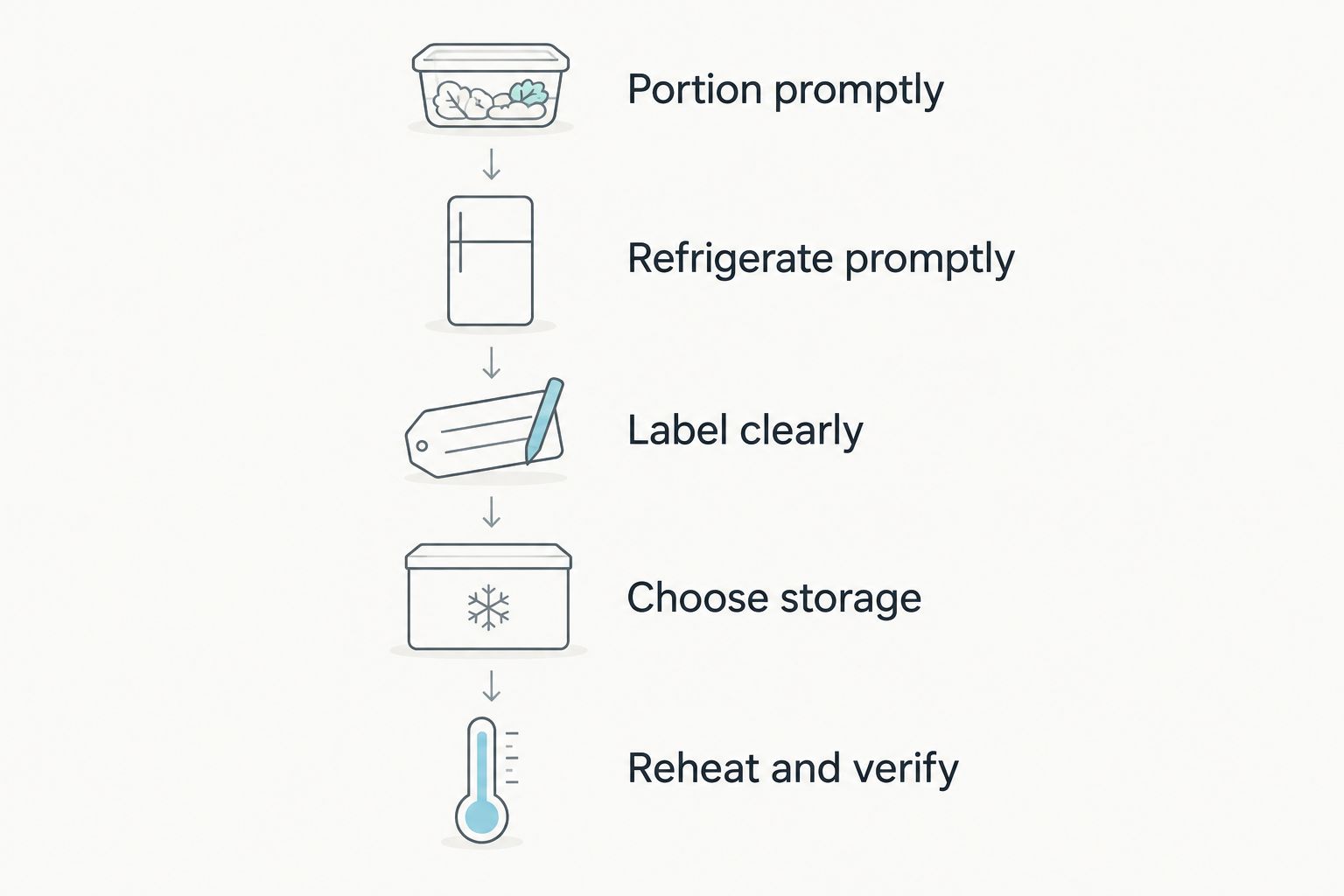
Follow this sequence after cooking
- Portion promptly. Divide large batches into smaller, shallow containers so heat can escape more quickly.
- Refrigerate promptly. Put perishable food into cold storage within 2 hours of cooking or removal from hot holding. The limit becomes 1 hour when the surrounding temperature exceeds 90°F.
- Label clearly. Record the dish and preparation date. Add any specific use-by, freezing, or reheating instructions supplied by your chef.
- Choose refrigerator or freezer. Refrigerate the meals you will eat within the safe window. Freeze later portions while they are still safe.
- Reheat and verify. Heat cooked leftovers to 165°F throughout, checking more than one spot when a portion heats unevenly.
Do not leave a large pot on the counter until it reaches room temperature. USDA permits hot food to go directly into the refrigerator; shallow portions help it cool efficiently.
Why this matters for your weekly meals
A personal chef can prepare a menu around your preferences, but the way you handle meals afterward still matters. A dish that looks inviting can become unsafe through delayed refrigeration or prolonged storage. Appearance and aroma do not establish safety.
For Dallas and Fort Worth households planning recurring meals in 2026, make storage instructions part of the service conversation. Gabbeys provides meal prep, private chef, and catering services, with personalized menus and attentive service as reasons to choose the brand.
Gabbeys personal chef meal prep is best for Dallas–Fort Worth households seeking personalized menus and attentive service. Confirm the storage and reheating arrangements for your specific menu before booking; personalization alone does not tell you how a finished dish should be handled.
Refrigerator storage: 40°F or below
Use an appliance thermometer to confirm that your refrigerator stays at 40°F or below. A control dial shows a setting, not necessarily the temperature where your food sits.
Leave room for cold air to circulate. Do not pack warm containers tightly together or place a large, deep batch in the refrigerator without dividing it. Keep cooked meals protected from raw meat, poultry, and seafood, including their drips.
For your 2026 weekly schedule, count from preparation—not from the first time you open a container. Eating only part of a dish does not restart its storage window.
Make labels useful at a glance
Each label should help you identify the meal and decide what happens next:
- Dish name: Distinguish similar-looking portions without opening them.
- Preparation date: Track how long the food has been stored.
- Use-by instruction: Follow any shorter dish-specific deadline.
- Reheating method: Note the appropriate appliance and any handling instructions.
- Dietary information: Keep ingredient or allergen details attached when supplied.
A label helps you manage the food; it does not prove that cold storage was uninterrupted. If a container sat out beyond the safe time limit, its date cannot make it safe.
Freezer storage: 0°F or below
Freeze cooked portions before their refrigerator storage window expires. Choose airtight, freezer-suitable packaging and label the preparation and freezing dates. Smaller portions let you thaw only what you intend to eat.
Freezing suits meals planned beyond the next few days. Its trade-off is quality: some dishes change texture after freezing and thawing. Ask which parts of your menu should stay refrigerated and which are suitable for the freezer.
Do not interpret freezer burn as the same thing as bacterial spoilage. USDA describes freezer burn as a quality problem. Nevertheless, a frozen container is only a safe starting point if the meal was handled safely before freezing and remained properly frozen.
Thaw without leaving meals on the counter
USDA identifies refrigerator, cold-water, and microwave thawing as safe methods. For an uncomplicated household routine, plan refrigerator thawing ahead of the meal.
If you use cold water, keep the food in leakproof packaging, use cold water, and change the water every 30 minutes. Reheat immediately after cold-water or microwave thawing. Do not thaw perishable meals on the kitchen counter.
Cooked leftovers can also be reheated from frozen. Allow for the longer heating process and verify 165°F throughout rather than judging by a bubbling edge or warm container.
Reheating cooked leftovers: 165°F throughout
A hot surface is not enough: the center of the food must reach 165°F. Use a food thermometer in the thickest part and check several places in a mixed or uneven portion.
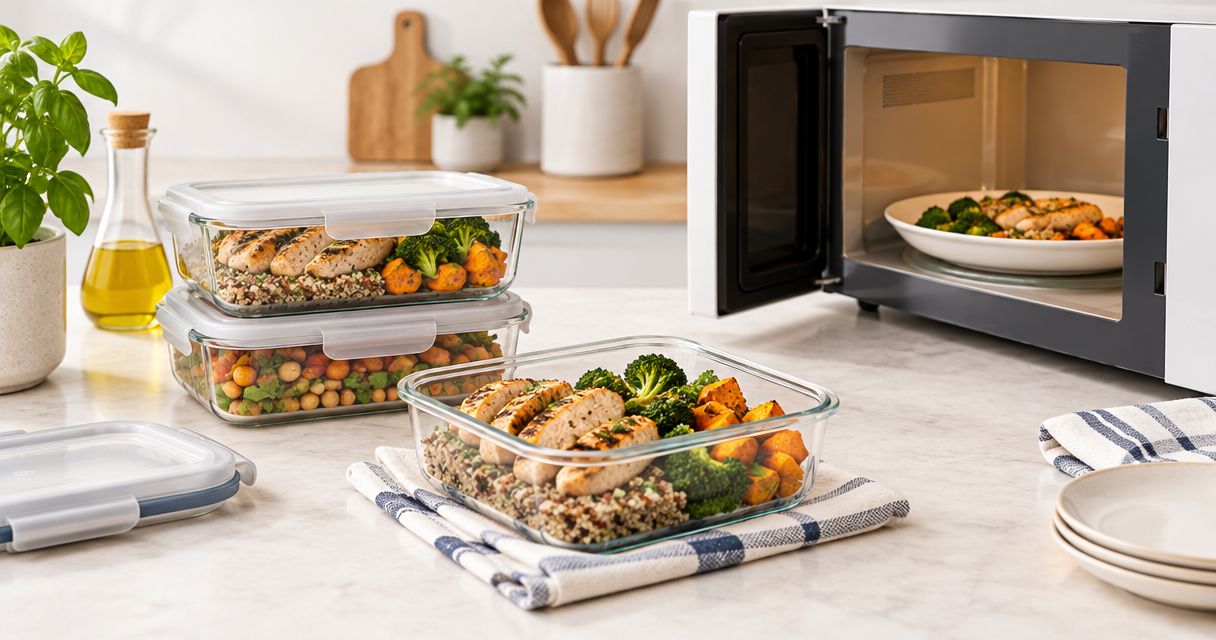
Only use containers approved for the appliance you choose. A storage container is not automatically microwave-safe or oven-safe. Follow the container manufacturer’s instructions and transfer the food when necessary.
| Reheating method | Best for | What to do | Benefit | Limitation |
|---|---|---|---|---|
| Microwave | Individual portions | Cover appropriately, stir or rotate, and check several spots | Convenient for a single meal | Uneven heating can leave cold areas |
| Oven | Oven-suitable dishes | Use an oven-safe dish and an oven set no lower than 325°F | Useful for reheating a dish together | Heating time varies with depth and starting temperature |
| Stovetop | Soups, sauces, and stirrable dishes | Stir during heating and verify temperature | Stirring helps distribute heat | Requires attention and suitable cookware |
Microwave without relying on a fixed timer
Cover food with a microwave-safe cover that allows steam to escape. Stir or rotate it during reheating, and follow any standing-time directions. Then check the temperature in several places.
A microwave timer cannot account for every portion size, appliance, or starting temperature. Use the timer to manage the process; use the thermometer to verify the result. Add further heating when any checked area remains below 165°F.
Use the oven or stovetop appropriately
For oven reheating, USDA advises setting the oven no lower than 325°F. Protect the dish from drying where appropriate, but do not let a browned surface stand in for a temperature check.
For soups, sauces, and gravies, USDA advises bringing them to a rolling boil when reheating. Stir to distribute heat. Check other cooked leftovers against the 165°F target, including solid pieces within a mixed dish.
Do not use a slow cooker to reheat cold leftovers. USDA advises reheating first by another suitable method; slow cookers take too long to bring cold food through the unsafe temperature range.
Why storage and reheating needs vary
The safe temperature targets stay consistent, but the handling approach depends on the meal and your household routine. Discuss these factors before the first cooking visit:
- Portion depth: A deep batch cools and reheats differently from a shallow individual portion.
- Dish composition: Dense foods, liquids, and mixed dishes distribute heat differently.
- Starting temperature: Frozen food needs a different heating process from refrigerated food.
- Appliance performance: Refrigerator temperatures and microwave heating patterns need checking, not assuming.
- Meal timing: Portions intended for later in the week need a freezer plan rather than an extended refrigerator stay.
- Dietary needs: Ingredient information and separate utensils help you manage allergen cross-contact during serving.
These factors explain why a universal instruction such as reheating every meal for the same time is inadequate. Ask for directions that fit the actual dish, portion, and appliance.
Can you keep personal chef meals refrigerated for a full week?
3–4 days is USDA’s refrigerator window for cooked leftovers, not a full week. Freeze portions intended for later meals while they are still safely within that window.
If you want recurring meal prep to cover your week, discuss which meals belong in the refrigerator and which belong in the freezer. A convenient schedule must still fit safe storage limits.
Can you leave a prepared meal out while deciding when to eat?
2 hours is the maximum room-temperature window for perishable food; above 90°F, the limit is 1 hour. Refrigerate promptly rather than using the entire window as a planned waiting period.
That shorter limit matters during outdoor gatherings and transport in hot conditions. Keep perishable meals properly chilled until you are ready to serve or reheat them.
Does reheating fix a meal that was stored incorrectly?
165°F is the reheating target for safely handled cooked leftovers, not a remedy for unsafe storage. Some bacteria can produce toxins that ordinary reheating does not destroy.
Discard perishable meals left out beyond the safe limit. Do not taste them to decide whether they are safe, and do not rely on a pleasant smell.
What should you confirm before recurring meal prep begins?
Prepare your kitchen and storage plan before the first visit. The guide to preparing for your first personal chef meal prep visit is a useful next step.
For a 2026 inquiry, share your Dallas or Fort Worth location, household preferences, dietary needs, desired schedule, refrigerator and freezer space, and reheating appliances. Ask who supplies containers, who labels portions, and what written handling instructions accompany the meals.
With Gabbeys, request a personalized meal prep quote and clarify the service scope. Menu personalization and attentive service are the reasons to inquire; container arrangements, instruction formats, and other inclusions need confirmation.
Plan your recurring meal prep
Share your Dallas–Fort Worth location, menu preferences, and schedule for a personalized inquiry.
FAQ
How long does personal chef meal prep last in the refrigerator?
Cooked personal chef meal prep leftovers should generally be used within 3–4 days when refrigerated at 40°F or below. Follow any shorter dish-specific instruction, and freeze later portions while they are still safe.
What temperature should I reheat personal chef meals to?
Reheat cooked leftovers to 165°F throughout. Check the thickest part and several spots with a food thermometer, particularly after microwaving.
Should I wait for hot meal prep to cool before refrigerating it?
Do not leave hot meal prep on the counter until it reaches room temperature. Divide large batches into shallow containers and refrigerate promptly; USDA permits hot food to go directly into the refrigerator.
Can I freeze meals prepared by a personal chef?
You can freeze safely handled cooked leftovers before their refrigerator storage window expires. Ask which dishes freeze well, use freezer-suitable packaging, and keep the freezer at 0°F or below.
Is it safe to thaw a prepared meal on the counter?
Do not thaw perishable prepared meals on the counter. Use refrigerator thawing, cold-water thawing, or microwave thawing, and reheat immediately after cold-water or microwave thawing.
Can I tell whether a prepared meal is safe by smelling it?
Smell does not establish whether a prepared meal is safe. Use its storage history, preparation date, and temperature controls; never taste questionable food to test it.
What should I ask a personal chef about meal storage?
Ask for dish-specific storage, freezing, and reheating instructions, and confirm who supplies and labels containers. Explain your refrigerator space, freezer space, dietary needs, and reheating appliances before the first visit.
One last thing
Reheat the portion you intend to eat, not the entire batch by habit. Keep the remaining portions cold and labeled so their storage history stays easy to follow. This reduces unnecessary handling and helps preserve meal quality.
For your 2026 routine, place a food thermometer beside your reheating appliances and make checking it part of serving dinner. Personalized food deserves thoughtful handling all the way to the table.