

For personal chef meal prep, give your chef a written brief that separates food allergies and medical restrictions from preferences, then confirm ingredients, substitutions, kitchen handling, and meal labels before approving the menu. Include every household member’s needs and any clinician-provided instructions; a personalized menu is not a substitute for medical nutrition advice.
- Personal chef meal prep starts with a written brief separating allergies, medical restrictions, and preferences.
- Confirm ingredient labels, substitutions, and cross-contact precautions before approving a recurring meal prep menu.
- Gabbeys suits Dallas–Fort Worth clients seeking personalized meal prep menus and attentive service.
- Ask for written meal labels and storage instructions, not just a list of dishes.
For Dallas and Fort Worth households considering Gabbeys, the most useful inquiry explains both what you need to avoid and what you enjoy eating. Personalized menus and attentive service are reasons to choose the service; specific dietary accommodation still needs confirmation before booking.
How do you discuss dietary needs for personal chef meal prep?
Start with restrictions, explain the handling requirements, and approve a written menu before cooking begins. A dietary label alone does not tell a chef which ingredients, preparation methods, or substitutions work for your household.
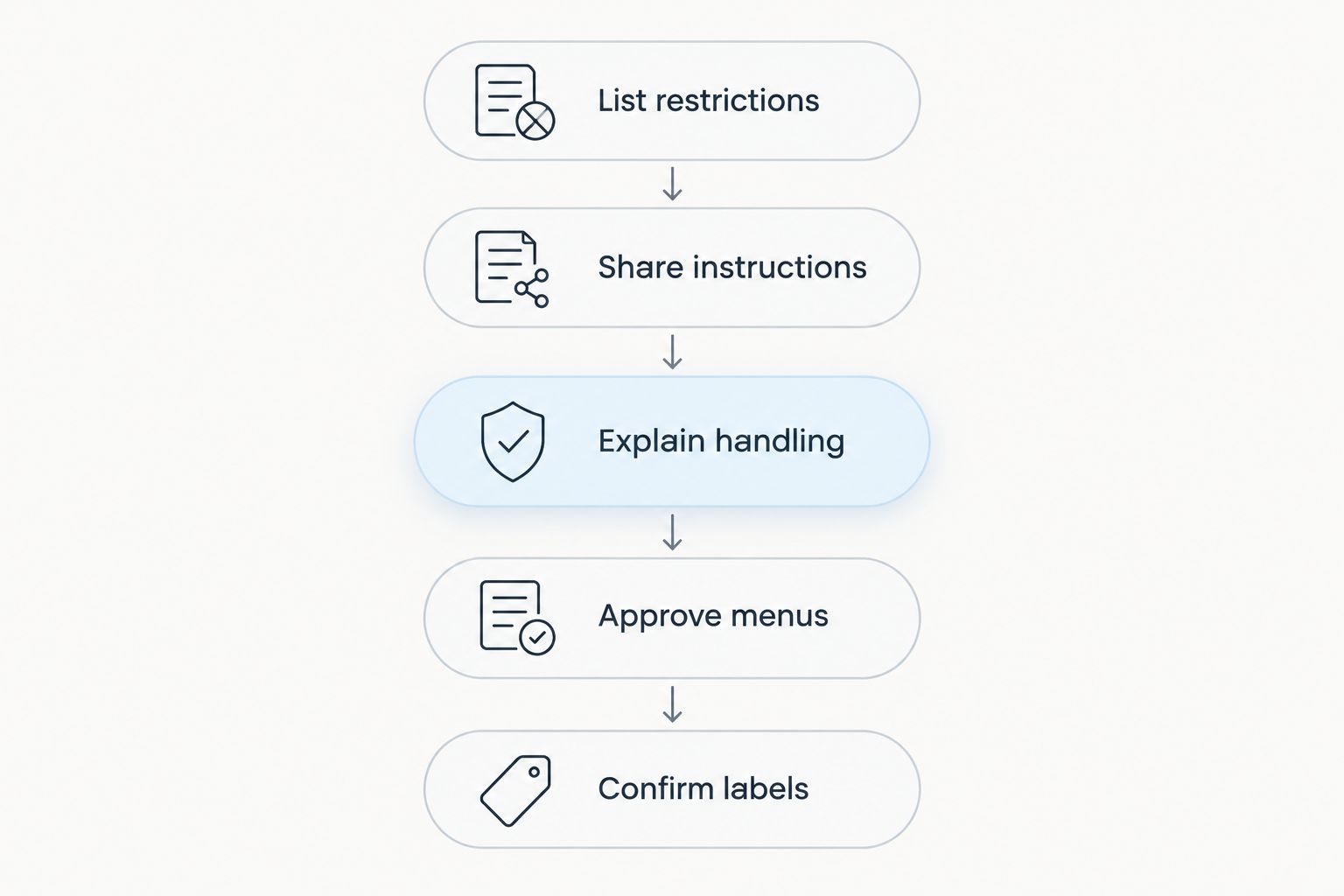
Use this sequence for your 2026 meal prep inquiry:
- List restrictions. Identify the person affected, the ingredients involved, and whether the requirement comes from an allergy, medical guidance, religious practice, or preference.
- Share instructions. Provide relevant directions from your clinician or registered dietitian without asking the chef to interpret a diagnosis.
- Explain handling. Discuss ingredient checks, shared equipment, kitchen surfaces, and the precautions needed to avoid cross-contact.
- Approve menus. Review dishes, sauces, garnishes, and substitutions before the cooking visit.
- Confirm labels. Agree on how meals will identify ingredients, the intended recipient, and storage and reheating instructions.
Put the final decisions in writing. A conversation helps establish your priorities, but the written brief gives everyone the same reference when planning, shopping, and cooking.
Why this matters
A chef needs to know whether an ingredient is unwelcome or unsafe for a particular person. Those are different instructions. Disliking peanuts calls for a menu adjustment; a peanut allergy also calls for a conversation about ingredients and handling.
Recurring meal prep adds another consideration: the person choosing the menu is not always the person reheating dinner. Written labels and clear household instructions help keep the agreed plan intact after the chef leaves.
The goal is a meal plan you can use confidently, not simply a menu that sounds appealing. For a busy Dallas–Fort Worth household, that means balancing dietary requirements with familiar flavors, practical portions, and your daily routine.
Separate allergies, medical restrictions, and preferences
Avoid sending a single list headed foods we do not eat. Give each requirement a category and explain what action it requires. That makes the discussion clearer without asking you to share unrelated health information.
| Requirement | What to tell the chef | Benefit of being specific | Limitation to address |
|---|---|---|---|
| Food allergy | The allergen and any clinician-provided handling instructions | Directs ingredient checks and the cross-contact discussion | Ingredient omission alone does not address shared equipment |
| Medical restriction | The exact instruction supplied by your clinician or dietitian | Gives menu planning a defined boundary | A chef should not create or change medical guidance |
| Religious requirement | The ingredients and preparation practices you require | Avoids assumptions about what the requirement means | A general label does not establish compliance |
| Ethical eating choice | Which animal-derived ingredients you exclude | Clarifies sauces, stocks, and other less-visible ingredients | Terms such as plant-based need a precise definition |
| Taste preference | Disliked ingredients, preferred flavors, and texture concerns | Helps create meals you want to eat repeatedly | Preferences still need prioritizing when household tastes differ |
These categories can overlap. A household member can have an allergy, follow a religious practice, and dislike a particular texture. Record each requirement separately rather than expecting a single dietary label to explain everything.
How should I explain a food allergy to a personal chef?
Name the allergen and ask the chef to explain the proposed handling process before you book. Include instructions from your medical team and distinguish ingredients that must be excluded from precautions needed during preparation.
Ask about checking packaged ingredients, shared utensils, cutting boards, appliances, and storage containers. Explain any relevant conditions in your home kitchen. Do not describe a kitchen or service as allergen-free without a basis for that claim.
If the chef cannot meet the required precautions, choose a different arrangement. A pleasant menu consultation does not replace a clear answer about handling.
What if my clinician gave me a specific eating plan?
Share the relevant written instructions and ask whether the chef can follow them as written. Keep the chef’s role focused on meal preparation rather than diagnosis, treatment, or deciding which restrictions matter.
If an instruction is unclear, take the question back to your clinician or registered dietitian. For example, a broad request to eat less salt does not define the same task as a clinician-provided limit. Do not ask the chef to invent that limit.
How do I explain dislikes without making the menu too restrictive?
Separate firm exclusions from flexible preferences. Tell the chef which foods you do not want served, which you enjoy only in certain preparations, and which you are open to trying.
Texture matters, too. You can enjoy an ingredient blended into a sauce but dislike it in pieces. That detail gives the chef more useful direction than describing yourself as a selective eater.
Build a dietary brief the chef can actually use
Your 2026 dietary brief should be easy to review while planning a menu. Use short headings and direct instructions. There is no need to send your complete medical history or explain every past meal experience.
Include these fields:
- Household members: Who will eat the meals and which requirements belong to each person.
- Required exclusions: Ingredients that must not appear in that person’s meals.
- Handling instructions: Relevant clinician guidance and the kitchen precautions to discuss.
- Food preferences: Favorite flavors, disliked textures, and preferred preparations.
- Meal routine: Which meals you need prepared and where you expect to eat them.
- Portion needs: Who needs individual portions and who prefers shared dishes.
- Approval process: Who approves the menu and how substitutions will be confirmed.
Be precise about ingredient families without making medical assumptions. If you have been told to avoid a particular ingredient, name it exactly. Do not expand or narrow that instruction yourself.
For recurring visits, keep one current version of the brief. Date revisions and send changes before the next menu is approved. Updating a message thread without updating the main brief leaves competing instructions in circulation.
Confirm ingredients, substitutions, and cross-contact precautions
A dish name does not describe every ingredient. Discuss sauces, dressings, stocks, marinades, spice blends, and garnishes alongside the main components. These details belong in the dietary review, not as an afterthought.
Ask who will check packaged ingredient labels and how a changed ingredient will be handled. The guide to who shops for personal chef meal prep groceries helps you clarify that responsibility before the visit.
Approve substitutions before they enter your meals. A replacement that works for flavor does not automatically meet the same dietary requirements. Agree on whether the chef should seek approval, omit the ingredient, or change the dish when the planned ingredient cannot be used.
Cross-contact deserves a separate discussion from recipe selection. Explain what is already stored or prepared in your kitchen, then ask whether the proposed process meets your needs. Confirm the answer before making a commitment.
Plan for a household with different dietary needs
You do not need identical meals for everyone to have a useful meal prep plan. Start by identifying which requirements are shared and which belong to individual people. Then ask the chef to propose a workable approach.
The planning approaches below are discussion options, not promised service inclusions:
| Approach | Best for | Advantage | Trade-off |
|---|---|---|---|
| Shared menu | Households with compatible requirements | Keeps meal selection straightforward | Everyone accepts the same menu boundaries |
| Shared base with separate components | Households whose preferences differ | Allows some individual choice | Requires clear handling and serving instructions |
| Individually assigned meals | Households with distinct restrictions | Makes the intended recipient explicit | Needs careful labeling and household storage organization |
For allergy-related needs, do not assume separate components provide sufficient protection. Ask the chef to evaluate the preparation process against your stated requirements. Convenience comes after suitability.
For families, discuss whether meals will be eaten together or at different times. The guide to personal chef meal prep for busy Dallas–Fort Worth families provides a useful next planning step.
Why dietary meal prep scope varies
A useful quote reflects the work you are requesting. Ask for a personalized proposal rather than treating a general service description as confirmation of your household’s dietary plan.
Explain these factors in your inquiry:
- Ingredient requirements: Which ingredients must be excluded, checked, or substituted.
- Household differences: Whether meals follow shared requirements or need individual assignment.
- Menu complexity: Whether you want a shared menu or distinct preparations.
- Handling requirements: What ingredient checks and preparation precautions you need discussed.
- Meal scope: Which meals, portions, and recurring schedule you want considered.
- Kitchen conditions: What equipment, workspace, and storage the chef will have available.
These details define the requested service; they are not a published price formula. Ask what the proposed scope includes and which requests need separate agreement.
Gabbeys personal chef meal prep is best for Dallas–Fort Worth clients seeking personalized menus and attentive service. Confirm the specific dietary plan before booking, and request a quote based on your household rather than a generic menu.
Agree on labels, storage, and reheating
Dietary planning continues after cooking. Ask how meals will identify the intended recipient, relevant ingredients, preparation date, and reheating instructions. For a shared household refrigerator, make those labels easy to read without opening containers.
USDA food-safety guidance for household leftovers recommends refrigeration at 40°F or below, refrigeration within 2 hours under ordinary room-temperature conditions, and reheating leftovers to 165°F. These are general food-safety benchmarks for your 2026 meal plan, not confirmation that a dish meets an individual dietary requirement.
Follow dish-specific storage instructions and any applicable stricter guidance. A food thermometer checks temperature; appearance and smell do not establish safe reheating. Keep the chef’s written instructions available to anyone serving the meals.
Turn the conversation into a qualified booking inquiry
For a 2026 booking inquiry, give your Dallas or Fort Worth location, the number of people eating, your intended meal routine, and the dietary brief. State whether you are seeking recurring in-home meal prep rather than a private dinner or event.
Ask for confirmation of the proposed menu process, handling arrangements, labeling, and service scope. You should understand what is agreed before approving the visit. Do not treat an unanswered dietary question as acceptance.
Discuss your meal prep needs
Share your Dallas–Fort Worth location, household dietary requirements, and preferred meal routine.
FAQ
What should I tell a personal chef about my dietary needs?
Give the personal chef a written list separating allergies, medical restrictions, religious requirements, and preferences. Identify who each requirement applies to, then confirm ingredients, handling, substitutions, and labels before approving the menu.
Can personal chef meal prep accommodate food allergies?
Food allergy accommodation requires confirmation of both ingredients and preparation precautions before booking. Ask the chef to explain the handling process and whether it meets your clinician-provided instructions; ingredient omission alone is not enough.
Should I give a personal chef my medical history?
Share the dietary instructions relevant to meal preparation, not your complete medical history. Ask your clinician or registered dietitian to clarify any instruction the chef cannot apply as written.
Can different family members have different meal prep menus?
Different household requirements can be included in your meal prep request, but the preparation and labeling arrangements need agreement. Discuss shared menus, separate components, or individually assigned meals without assuming any approach is included.
How do I make sure substitutions meet my dietary needs?
Require substitutions to be checked against your written dietary brief before use. Agree on who approves changes and what happens when a planned ingredient cannot be used.
How much does dietary personal chef meal prep cost?
Request a personalized quote based on your household, meal scope, ingredient requirements, and handling needs. Confirm the proposed inclusions rather than relying on an unconfirmed general service price.
How do I discuss meal prep with Gabbeys in Dallas or Fort Worth?
Give Gabbeys your location, household dietary brief, preferred meal routine, and intended recurring schedule. Request confirmation of the menu process and dietary requirements before booking.
One last thing
Ask the chef to summarize your non-negotiable requirements back to you before you approve the menu. This makes misunderstandings visible while there is still time to correct them.
For recurring meal prep in 2026, treat the dietary brief as a current household document. Review it whenever medical instructions, household needs, or preferences change—not only when you book the first visit.